
Technology

The Three Pillars of Veteran Services: How AI Helps Counties Keep Up with Transportation, VA Claims, and Financial Assistance

The Three Pillars of Veteran Services: How AI Helps Counties Keep Up with Transportation, VA Claims, and Financial Assistance

County veteran service offices support veterans across three core needs: transportation to VA medical care, help with VA claims and benefits, and emergency financial assistance. Nearly all that help starts with a phone call. AI virtual assistants like EVA Phone answer those calls 24/7/365, handle routine questions, and gather the information staff need, so service

The Three Pillars of Veteran Services: How AI Helps Counties Keep Up with Transportation, VA Claims, and Financial Assistance Read More »

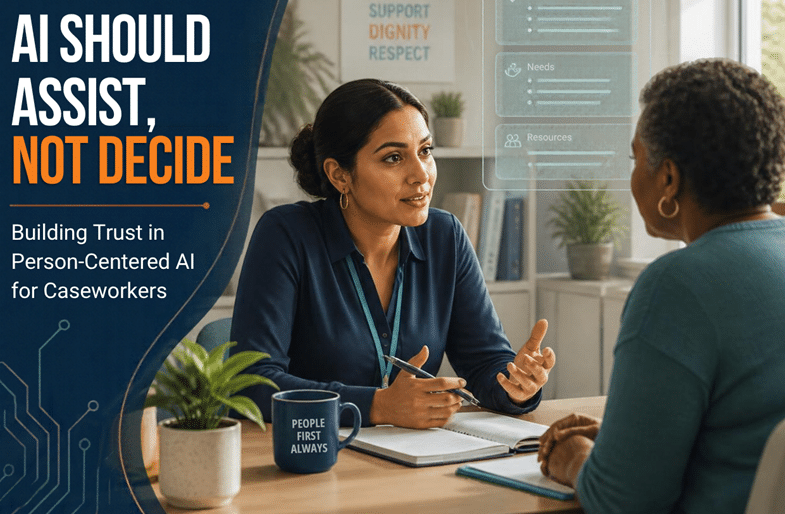
AI Should Assist, Not Decide: Building Trust in Person-Centered AI for Caseworkers

AI Should Assist, Not Decide: Building Trust in Person-Centered AI for Caseworkers

Person-centered AI in human services means technology supports caseworkers while people keep the final say on every eligibility and case decision. AI takes on repetitive, high-volume tasks like answering routine calls, reciting required language, and finding policy answers, so caseworkers have more time for the judgment calls and conversations that only people can handle.

AI Should Assist, Not Decide: Building Trust in Person-Centered AI for Caseworkers Read More »

Ready for January 2027? What County DSS Agencies Need from Their AI Partner Now

Ready for January 2027? What County DSS Agencies Need from Their AI Partner Now 

On January 1, 2027, Centers for Medicare & Medicaid Services (CMS)’s interim final rule on Medicaid community engagement requirements takes effect, requiring states and counties to verify work participation for a defined share of Medicaid recipients—on top of the SNAP ABAWD and TANF work-requirement tracking many eligibility teams already manage. For agencies already running lean,

Ready for January 2027? What County DSS Agencies Need from Their AI Partner Now  Read More »

Doing More with Less: How AI Automation Helps Counties Offset Rising Service Costs

Doing More with Less: How AI Automation Helps Counties Offset Rising Service Costs

AI automation lets counties absorb rising mandated costs without cutting services or overriding the property tax cap—by automating the high-volume, repetitive work that currently consumes staff time, like routine phone inquiries, policy lookups, and mandated script recitations. That answer matters more this year than most. State and federal mandates keep growing, while the aid meant

Doing More with Less: How AI Automation Helps Counties Offset Rising Service Costs Read More »

When AI Leaders Hit the Brakes, TipCo Was Already Driving Carefully

When AI Leaders Hit the Brakes, TipCo Was Already Driving Carefully 

Last weekend, a wave of headlines put AI safety back in the national spotlight after the CEO of a major AI company published a widely discussed essay calling on the industry to deliberately slow the pace of model development. The argument: AI capabilities are advancing faster than researchers’ ability to understand and control them, and

When AI Leaders Hit the Brakes, TipCo Was Already Driving Carefully  Read More »

Beyond Inbound—How Automated Outbound Communication Gives County Staff Time Back

Beyond Inbound—How Automated Outbound Communication Gives County Staff Time Back 

Most conversations about AI-powered virtual assistants focus on one thing: answering the phone when it rings. That’s important work, but it’s only half the need.  The other half—the half that often gets overlooked—is what happens before the phone rings. The reminder calls, document request notifications, status updates, and appointment confirmations. These are the everyday, repetitive

Beyond Inbound—How Automated Outbound Communication Gives County Staff Time Back  Read More »

AI in Public Sector Workflows: How County Governments Are Reducing Redundant Calls and Improving Communication

AI in Public Sector Workflows: How County Governments Are Reducing Redundant Calls and Improving Communication

Picture a typical morning at a county agency. Before noon, staff answered the same five questions dozens of times: What are your hours? How do I pay my property taxes online? Where do I go to renew my business license? What’s the status of my permit? Did you receive my application? These aren’t unimportant questions.

AI in Public Sector Workflows: How County Governments Are Reducing Redundant Calls and Improving Communication Read More »

Stop Waiting, Start Crawling: How HHS Agencies Can Take the First Step on AI

Stop Waiting, Start Crawling: How HHS Agencies Can Take the First Step on AI

At health and human services agencies across the country, there are conversations happening about AI that include phrases like these: We understand that instinct to be cautious. AI is moving fast, the policy landscape is complicated, and nobody wants to make a costly mistake. But the workforce crisis isn’t waiting; agency caseloads aren’t decreasing, and

Stop Waiting, Start Crawling: How HHS Agencies Can Take the First Step on AI Read More »

Putting the Human Back in Human Services: How AI Creates More Space for Empathy

Putting the Human Back in Human Services: How AI Creates More Space for Empathy

A question that often comes up when TipCo talks about AI with health and human services agencies: Are you worried about losing the human side of human services? It’s a good question and our answer might surprise you. No, we’re not worried. In fact, TipCo believes that AI is one of the best opportunities we’ve had

Putting the Human Back in Human Services: How AI Creates More Space for Empathy Read More »

Real Results, Real Stories: How New York Counties Are Using EVA to Transform Benefits Delivery

Real Results, Real Stories: How New York Counties Are Using EVA to Transform Benefits Delivery

At the New York Public Welfare Association’s (NYPWA) 2026 Winter Conference, TipCo moderated a panel session that didn’t feel much like a typical conference presentation. There were real conversations, metrics, and effects on staff. Three New York county commissioners—Sarah Merrick of Onondaga County, Kira Pospesel of Greene County, and Don Horan of Allegany County—sat down

Real Results, Real Stories: How New York Counties Are Using EVA to Transform Benefits Delivery Read More »

Scroll to Top