
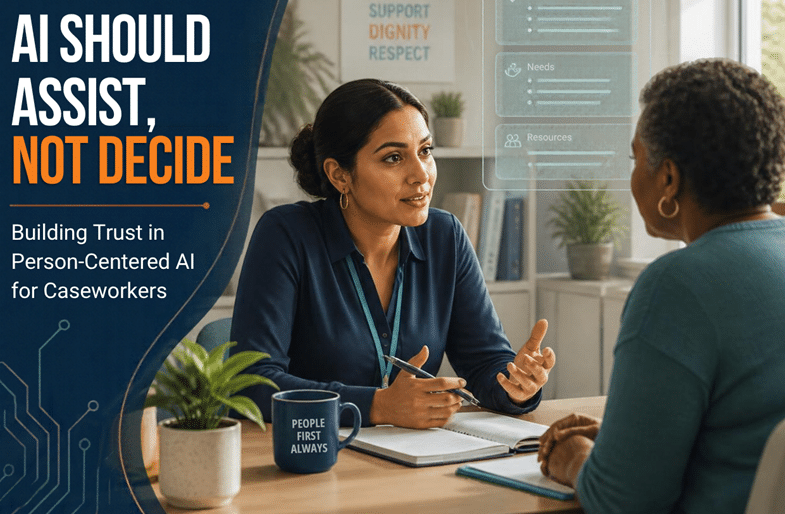

Person-centered AI in human services means technology supports caseworkers while people keep the final say on every eligibility and case decision. AI takes on repetitive, high-volume tasks like answering routine calls, reciting required language, and finding policy answers, so caseworkers have more time for the judgment calls and conversations that only people can handle.
That principle is getting more attention across the field. In May 2026, the American Public Human Services Association’s (APHSA) The Catalyst blog published Person-Centered AI in Human Services: Letting Technology Assist, Not Decide, which argues that trained staff should make final determinations and that AI should inform, not replace, those decisions. For county Health and Human Services (HHS) leaders weighing the use of AI, the question isn’t only what a tool can do. It’s whether caseworkers will trust it enough to use it.
What Does “Person-Centered AI” Mean for Caseworkers?
Person-centered AI is designed around the people in the process: the residents applying for help and the workers serving them. In practice, that means three things:
- People make decisions. AI can gather information, answer routine questions, and complete scripted steps, but eligibility and case decisions stay with agency staff.
- AI handles the repetitive work. The best targets for AI to handle are high-volume, predictable tasks that pull caseworkers away from complex cases.
- Every interaction can be reviewed. Staff can see what the AI said and did, so they can check its work and step in when needed.
This is the approach TipCo has taken with EVA from the start. As we wrote in When AI Leaders Hit the Brakes, TipCo Was Already Driving Carefully, EVA supports workers and agency staff; it does not make eligibility or case decisions on its own.
Why Does Human-in-the-Loop Design Matter in Human Services?
Human services cases are rarely simple. A household’s situation can change quickly, documentation can be incomplete, and policy often leaves room for interpretation. The APHSA article makes the point directly: “Human judgment remains essential” when cases involve complex circumstances.
Human-in-the-loop design keeps AI in a supporting role for exactly that reason. It’s also not a sign of distrust in the technology. As the article puts it, “Human-in-the-loop is not about distrust of technology.” It’s about putting each task in the right hands.
How Do You Build Caseworker Trust in AI?
Trust comes from understanding. Caseworkers are more likely to adopt AI when they know what it does, can see its work, and have a say in how it’s set up. The APHSA article highlights transparency, governance, and change management as foundations for adoption. Here’s how those principles show up in day-to-day practice with EVA.
Give Staff Visibility Into Every Interaction
EVA creates transcripts so staff can review what was said. With EVA R&R, transcripts and verbal attestations are captured in the EVA dashboard, where workers can view and filter them. Sarah Merrick, Commissioner of Onondaga County Department of Social Services (DSS), described the effect on phone calls: “With EVA, every call is recorded, stored, and transcribed. We have tripled our documentation ability.”
Let the Agency Control What AI Says
EVA is configurable, and counties choose which configurations they want EVA to handle. Agencies approve the Rights and Responsibilities language EVA uses, and they review and test EVA’s responses before launch. That keeps policy language in the agency’s hands, not the vendor’s.
Ground AI Answers in the Agency’s Own Resources
EVA Companion gives caseworkers instant answers from their desktops by sourcing organization-provided resources, such as policy manuals and training materials. Because answers come from documents the agency provides, staff can trust that guidance reflects their own policies.
Route Sensitive Situations to People
EVA measures sentiment on every call. If threatening intent is detected, the call is flagged and routed according to the county’s configuration so a person can respond.
Keep Staff Informed About Changes
Before any update, TipCo provides release notes through the EVA dashboard. Staff know what’s changing and how it affects their work, which prevents surprises that erode trust.
What Tasks Should AI Handle, and What Should Stay With People?
A useful test: If a task is scripted, repetitive, and the same for every case, it’s a strong candidate for AI. If it requires judgment, discretion, or a decision about someone’s benefits, it belongs with a caseworker.
Good fits for AI:
- Answering routine questions about office hours, directions, and how to apply
- Reciting required Rights and Responsibilities language and capturing audio signatures
- Gathering interview information and completing related forms for worker review
- Finding answers in policy manuals and training materials
Tasks that stay with people:
- Eligibility and case decisions
- Complex or unusual household situations
- Conversations that call for empathy, discretion, or problem-solving
For more on how shifting routine work creates room for these conversations, see “Putting the Human Back in Human Services: How AI Creates More Space for Empathy.”
What Happens When AI Supports Caseworkers Instead of Replacing Them?
When AI takes on routine work, caseworkers get time back for the cases that need them. At Greene County DSS in New York, staff faced post-pandemic workforce shortages. After adding EVA R&R and EVA Phone, SNAP timeliness improved from 55% to 85%, late SNAP cases dropped from 24% to 0%, and overtime costs were eliminated.
Staff noticed the difference, too. Greene County Commissioner Kira Pospesel shared: “Other departments got a little jealous, and they asked me, ‘Boy, your staff seems happy.’”
Key Takeaways
- Person-centered AI supports caseworkers; it doesn’t make eligibility or case decisions.
- Human-in-the-loop design keeps complex judgment calls in the hands of trained staff.
- Caseworker trust grows from transparency: transcripts, agency-approved language, and clear release notes.
- The best tasks for AI are scripted, repetitive, and high-volume.
- When AI handles routine work, agencies like Greene County DSS have seen faster, more timely case processing without overtime.
Frequently Asked Questions
Caseworkers and agency leaders often have questions about how AI fits into human services, so we’ve answered the most common ones here.
What is person-centered AI in human services?
Person-centered AI is technology designed around the residents and workers in human services. It handles repetitive tasks and supports caseworkers, while people keep authority over eligibility and case decisions.
Does AI make eligibility decisions?
It shouldn’t, and EVA doesn’t. EVA supports workers and agency staff, but eligibility and case decisions remain with agency staff.
Will AI replace caseworkers?
No. Person-centered AI is designed to take repetitive work off caseworkers’ plates so they can focus on complex cases and conversations that require human judgment.
How can agencies build caseworker trust in AI?
Give staff visibility into what the AI does through transcripts, let the agency approve the language the AI uses, involve staff in testing, and communicate clearly when anything changes.
What does human-in-the-loop mean?
Human-in-the-loop means a person reviews, approves, or makes the final call on anything that matters. AI can inform the work, but trained staff make the decisions.
See EVA in Action
EVA is built to support your caseworkers, not replace them. Book a demo to see how EVA can take routine work off your team’s plate.


