
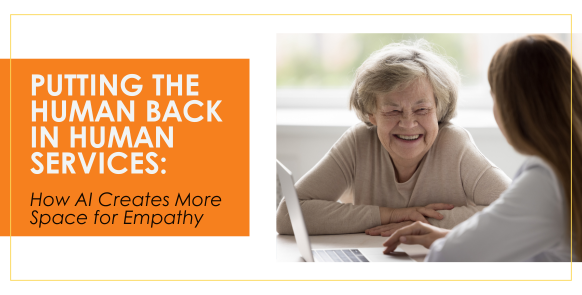

A question that often comes up when TipCo talks about AI with health and human services agencies: Are you worried about losing the human side of human services? It’s a good question and our answer might surprise you.
No, we’re not worried. In fact, TipCo believes that AI is one of the best opportunities we’ve had in a while to put the human back into human services. Here’s what we’re seeing.
The Human Side is Hard to Find
Before we can talk about protecting the human element in human services, we need to be frank about where things are today.
The workers who got into this field, the caseworkers, eligibility workers, and benefits coordinators, most of them came because they wanted to help people. They wanted to sit across from a family or individual in need of assistance and make a difference. That includes connecting with them, problem-solving, and serving as a resource for what’s available.
What are workers often spending their time on instead?
- Answering routine phone calls about case status and office hours
- Reading rights and responsibilities aloud for every case
- Entering data and processing paperwork
- Searching through pages of policy manuals for a single citation
The question of whether AI will make things less human assumes that things are very human right now. For many agencies, that’s not the reality. Workers who started at the agency to help people have been transformed into data-collection specialists because of the volume of administrative work on their plates.
AI doesn’t create that problem, but it does create an opportunity to solve it.
What Happens When You Give Workers Their Time Back
When EVA helps to answer incoming calls using publicly available information, things begin to shift within the agency. A caseworker who would have spent the first two hours of their day on routine phone calls now has two hours to do something different.
So, what can they do with that time?
- Work through their caseload more carefully and thoroughly
- Catch errors before they become compliance problems
- Follow up on cases that need additional attention
- Sit with a client who is struggling and have the time to listen
That’s what we mean by putting the human back in human services. Not replacing the worker but giving them time back in their day to do that work.
In Greene County, New York, after implementing EVA, timeliness rates went from 52 percent to 84 percent for public assistance cases. SNAP late cases dropped to zero percent. The commissioner was able to stop buying overtime and get her examiners back to their desks. Those aren’t just efficient metrics; they’re a reflection of what workers can accomplish when they’re not buried under administrative tasks that don’t require their expertise.
In Onondaga County, Commissioner Sarah Merrick put it simply: EVA Phone handles 28% percent of the county’s incoming calls. That represents weeks of time saved for staff, weeks that can now be redirected toward the work that needs a human being.
The Truth About AI and Empathy
Here’s the part that isn’t typically shared: AI, deployed thoughtfully in human services, creates more opportunities for empathy, not fewer.
Think about what a caseworker can do with an extra 40 to 45 minutes per interview engagement:
- Ask follow-up questions instead of quickly moving to the next call or appointment
- Notice when something in a case seems off and slow down
- Help a client connect with a resource they didn’t know existed
- Treat the person in front of them, or on the phone, like a person, not a case number
Crisis doesn’t happen Monday through Friday, 8 to 5. But for most agencies, that’s the only window when help is quickly available. EVA is available 24/7/365, which means a client who can’t step away from work during business hours can call after their shift ends. That’s not less human—that’s more accessible, more equitable, and more dignified service delivery.
Rethinking the Question
Debbie-Ann Anderson, Director of Union County Department of Human Services in New Jersey, said it well during a podcast with the TipCo team: “Rethinking service delivery means embracing tools that help us be more responsive, more inclusive, more human. We’re not just transforming how we work—we’re transforming how people experience help.”
The question isn’t whether AI will make government services less human. The better question is: what would it mean for the people served if the workers helping them had the time and capacity to be fully present?
The workers want that, and the clients need that. And the technology to make it possible is here.
The Path Forward
At TipCo, we started with a problem, not technology. The problem was that caseworkers were drowning in administrative work and didn’t have time to do the job they came to do. AI turned out to be the answer.
The crawl, walk, run approach, starting with low-risk, high-value use cases like answering routine phone calls with publicly available data, isn’t just a smart implementation strategy. It’s a trust-building strategy, meaning:
- It gives workers the chance to see how EVA can help them with their daily work
- It gives clients the chance to experience a more responsive, accessible agency
- It gives agency leadership the data they need to make the case for doing more
If you’re worried about losing the human side of human services, we get it and know that that instinct comes from the right place. But the question we should be asking is this: how do we get it back?
Key Takeaways
- Most HHS workers became caseworkers to help people, but the administrative burden has turned many into data entry specialists with little time for meaningful client interaction.
- AI doesn’t replace the human element in human services; it creates the conditions for more of it by freeing workers from routine, repetitive tasks.
- Real results from agencies using EVA show that giving workers their time back directly improves outcomes: Greene County went from 52% to 84% timely public assistance cases and reduced SNAP late cases to 0%.
- EVA’s 24/7/365 availability expands access for clients who can’t call during business hours, making service delivery more equitable and more dignified.
- The crawl, walk, run implementation approach builds trust with workers, clients, and leadership, creating a foundation for doing more overtime.
Ready to Talk?
If you’re curious about what putting the human back in your agency might look like, or you’re ready to take the first step, we’d love to hear from you.
Contact the TipCo team today and let’s start the conversation.


